The Hub explains the method. 10x-cli installs it. 10xBench helps select a model.
SF THEME // WHERE THE VIBE COMES FROM
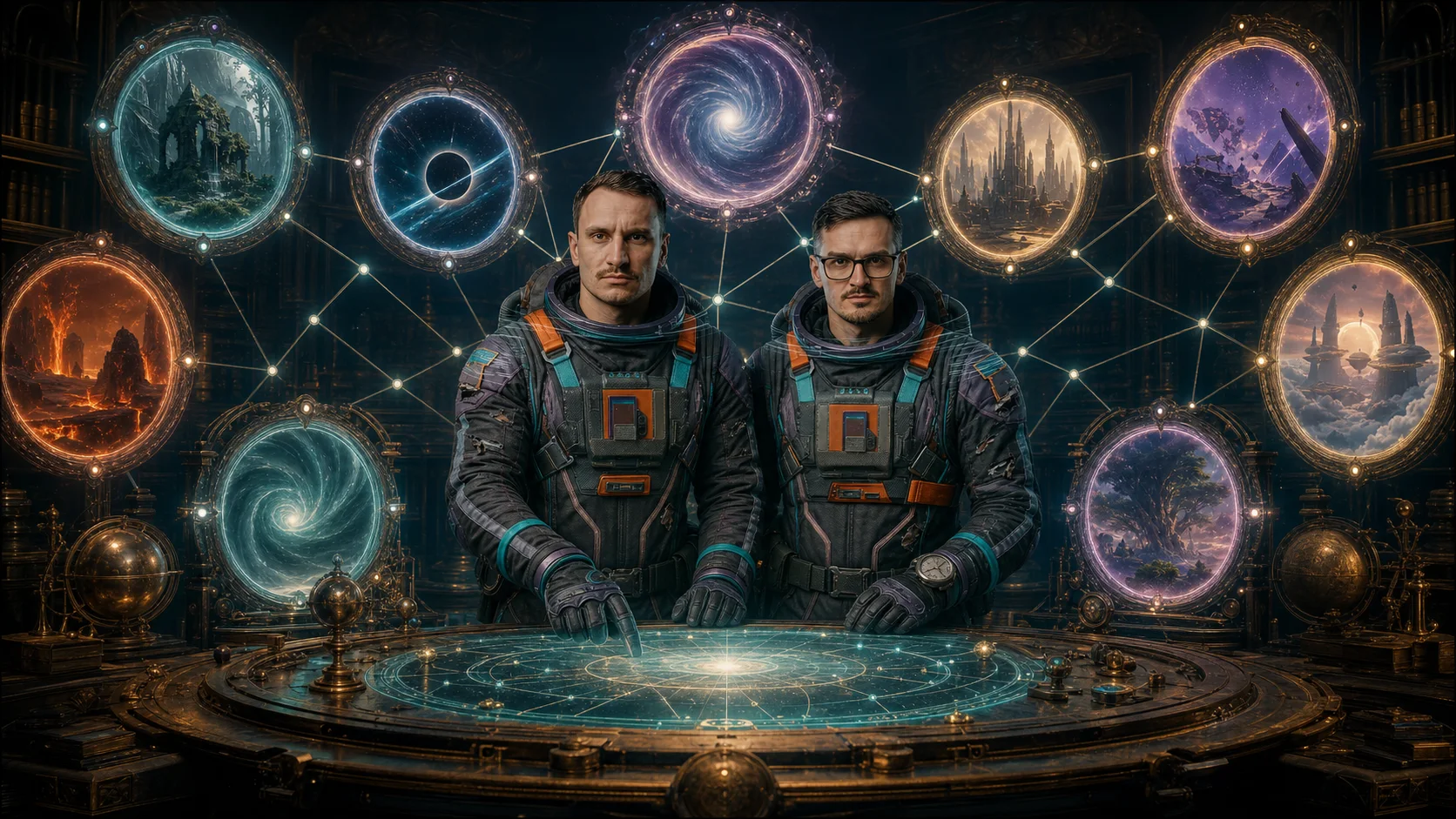
Marcin and Przemek like sci-fi
The cosmic vibe of 10xDevs 3.0 comes from the books we actually read. Every universe in the campaign has its color, its symbol and its reason - all ten are below.
SF THEME // CLICK A GLYPH TO FLY TO A UNIVERSE
The quick pass · ten universes in 30 seconds
Ender's Game
Battle School, simulations and command through frames - tactics you can read in two evenings.
SF-02The Three-Body Problem
Hard SF about science under pressure - what happens when the experiments stop adding up.
SF-03Hyperion
Seven pilgrims, seven tales - the strongest piece of writing in this set.
SF-04Dune
Ecology, politics and religion in one system - the worldbuilding everything else is compared to.
SF-05Warhammer 40k
The founding myth of the Imperium - military SF about how great institutions rot from within.
SF-06The Expanse
Physics with no free passes and the crew of the Rocinante - the campaign's strongest recommendation.
SF-07Star Wars
Thrawn: a commander who wins through analysis of his opponent, not a bigger fleet.
SF-08Foundation
Psychohistory and a plan for centuries - systems thinking at the scale of a galaxy.
SF-09Solaris
A first contact that is not a mirror of humanity - a Polish classic playing in the world league.
SF-10Red Rising
Ender meets Rome on Mars - a hierarchy of Colors and ascent by passing as the elite.
A good metaphor sticks better than a definition - so instead of inventing our own universes, we borrow from the best. You can switch the theme off with one toggle in the header.
Ender's Game
Orson Scott Card sends a child to Battle School, where everything is a game: simulations, armies, tactics in zero gravity. Ender wins not because he is the strongest, but because he is the first to flip the frame of reference - "the enemy's gate is down" - and fights the rest of the battle in better coordinates.
We recommend it because it is the best manual of command and teamwork disguised as an adventure novel: briefings, delegating to toon leaders, learning from replays. And the ending adds a grown-up question about the price of winning that the young-adult cover never hints at.
- Rating
- Goodreads - ★ 4.3 (approx. 1.5M ratings)
- Adaptation
- Ender's Game (2013) - 6.4 (approx. 81K ratings); the film flattens the novel - treat it as a trailer, not a substitute
- Symbol
- a gate with a downward arrow - "the enemy's gate is down": reframing the coordinate system before the battle starts
first on the list - pick it up when you want to see, in two evenings, how commanding through frames differs from commanding through orders.
The Three-Body Problem
Cixin Liu starts with physicists whose experiments stop adding up - and with the question of what that does to people who trusted the method their whole lives. Then come the Cultural Revolution, a strange VR game about a civilization on the unstable orbit of three suns, and a first contact that resembles nothing from the Hollywood playbook.
We recommend it because this is hard SF whose real protagonist is a thought experiment: the scale grows from a single laboratory to the fate of the species, and every plot twist follows from physics, not from the convenience of the script. The book teaches humility toward evidence - and that the observer changes the observed system.
- Rating
- Goodreads - ★ 4.1 (approx. 524K ratings)
- Adaptation
- 3 Body Problem (Netflix, 2024) - 6.6 (approx. 25K ratings); a solid entry point, but the book goes further and deeper
- Symbol
- three bodies on intersecting orbits - a system that cannot be predicted over a long horizon
pick it up when you want hard SF that takes evidence and the scientific method dead seriously - and is not afraid of civilizational scale.
Hyperion
Dan Simmons sends seven pilgrims to the Time Tombs, where the Shrike waits - and has each of them tell their own story along the way. The structure is straight out of "The Canterbury Tales", but every novella is a different genre: horror, romance, military SF, noir crime, cyberpunk. All of them converge at a single point of the route.
We recommend it because it is the strongest piece of writing in this set of ten - prose that beats most "serious" literature while being shamelessly inventive SF. The pilgrimage plan is simple; it is the pilgrims' tales that carry all the weight, exactly like a good plan for a change.
- Rating
- Goodreads - ★ 4.3 (approx. 313K ratings)
- Adaptation
- none - the project has been stuck in development since around 2009 (first Syfy, then Warner Bros.), still without a director or a release date; the book remains the only way into this world
- Symbol
- the hourglass of the Time Tombs with the Shrike's spike - time flowing backward and the price of the meeting at the end of the route
pick it up when you want SF written like great literature - and you do not mind that the full answers arrive only in "The Fall of Hyperion".
Dune
Arrakis is the only source of spice in the known universe, so the politics of the great houses, desert ecology, religion and economics form one coupled system in Frank Herbert's hands. Change a single variable - water - and everything changes: Fremen culture, military strategy, messianism. The Bene Gesserit design their trials generations ahead, and the gom jabbar filters out in a minute what stays invisible for years.
We recommend it because this is the benchmark of worldbuilding the rest of the genre is measured against - and the purest training in systems thinking in the form of a novel. This universe carries four metaphors in the campaign, from the shape of a project to quality gates.
- Rating
- Goodreads - ★ 4.3 (approx. 1.7M ratings)
- Adaptation
- Dune (2021) - 7.6 (approx. 216K ratings) · Dune: Part Two (2024) - 8.1 (approx. 150K ratings); part three announced for December 2026
- Symbol
- the arc of a dune and a sandworm surfacing from the sand - a system that answers every rhythmic step on its surface
pick it up when you want to see systems thinking in action - before Villeneuve's films, or right after them, while the world is still in your head.
Horus Rising - the start of the Horus Heresy
Dan Abnett opens the Horus Heresy cycle with the line "I was there the day Horus slew the Emperor" - and spends the rest of the book showing the Imperium at the peak of its glory, already sprouting the cracks that will blow it all apart. The Astartes Legions, the Great Crusade, loyalty, propaganda - and the first decisions that will prove catastrophic dozens of volumes later.
We recommend it because Abnett writes military SF with a seriousness nobody expects from a universe born of a tabletop game: it is a story about how the greatest institutions rot from within, and how technology turns into ritual once nobody understands how it works anymore. The best possible entry into WH40k - no knowledge of the game required.
- Rating
- Goodreads - ★ 4.3 (approx. 42K ratings)
- Adaptation
- no full adaptation - Amazon's series with Henry Cavill is in development (realistically 2027+); for a taste of the vibe: an episode of the Secret Level anthology (Prime Video, 2024)
- Symbol
- the half-cog of the Adeptus Mechanicus - the machine cult: technology worshipped because nobody can repair it anymore
pick it up when you work with legacy and want a founding myth about the entropy of great systems - told from the inside, before it all came down.
Leviathan Wakes - The Expanse
James S.A. Corey splits the Solar System between Earth, Mars and the Belt - then drops into that cold conflict a detective from Ceres and a small crew that comes into possession of the Rocinante. Physics gets no free pass: thrust, deceleration, g-forces and orbits are real currency here, and the flip & burn maneuver hurts exactly as much as it should. Noir meets space opera and both come out better for it.
This is the strongest recommendation of the campaign - and the only one with personal proof: Marcin read all nine volumes in a year and a half and watched the entire series. The quality holds to the last page of the last volume, and the crew of the Rocinante is the best small team in SF.
- Rating
- Goodreads - ★ 4.3 (approx. 333K ratings)
- Adaptation
- The Expanse (2015-2022, 6 seasons) - 8.0 (approx. 27K ratings); one of the best SF adaptations in the history of television
- Symbol
- a triangular hull with a drive plume - the Rocinante: physics instead of magic, a crew instead of a lone hero
pick it up when you are looking for a series for months, not for a weekend - nine volumes that hold their level to the very end.
Footsteps of History - Clinton Shorter (The Expanse, season 4). This track played on loop while 10xDevs 3.0 was being built.
Heir to the Empire - the Thrawn trilogy
Timothy Zahn picks up five years after the Battle of Endor: the New Republic is still celebrating while the remnants of the Empire are gathered by Grand Admiral Thrawn - a commander who wins not with more ships, but with analysis. He studies the art of his opponent's civilization to predict their decisions in battle. This is the book that resurrected Star Wars in 1991 and built the entire old Expanded Universe.
We recommend it because this is the franchise two generations grew up on - represented here by the best novel it ever got. Thrawn is the model of the analyst-commander: preparation instead of bravado, research on the opponent instead of a bigger fleet. In the campaign this universe carries the metaphors of operational scale: the jump to hyperspace, the squadron and the shields.
- Rating
- Goodreads - ★ 4.2 (approx. 106K ratings)
- Adaptation
- Star Wars: A New Hope (1977) - 7.9 (approx. 354K ratings); point zero of the entire franchise - the Thrawn trilogy is still waiting for its adaptation
- Symbol
- a four-pointed starburst - hyperspace and the fleet: the scale of an operation, not a single fighter
pick it up when you know the films and want to see how someone commands after actually doing the research on their opponent.
Foundation
Using psychohistory - the mathematics of vast populations - Hari Seldon calculates that the Galactic Empire will fall and the dark ages will last thirty thousand years. Instead of saving the Empire, he founds the Foundation at the edge of the galaxy, meant to shorten the chaos to a thousand years. Crises are predicted generations in advance, and the Time Vault speaks up exactly when the plan requires it.
We recommend it because Isaac Asimov is the grandfather of the entire genre, and Foundation is the purest SF of ideas: few blasters, plenty of thinking on the horizon of institutions and systems. Every "plan that executes without its author" - including ours - has its prototype here.
- Rating
- Goodreads - ★ 4.2 (approx. 610K ratings)
- Adaptation
- Foundation (Apple TV+, 2021-) - 7.3 (approx. 10K ratings); a loose adaptation - it takes the ideas from the books, not the plot
- Symbol
- the spiral of the galaxy - the Seldon Plan: motion visible only at the scale of centuries
pick it up when you want the source - thinking about plans longer than one lifetime started with Seldon's psychohistory.
Solaris
Stanisław Lem sends psychologist Kris Kelvin to a research station above an ocean-planet that humanity has been studying for decades with no result. The ocean does not answer signals - instead it sends the crew "visitors": materializations of their most deeply buried memories. For Kelvin, it is his dead wife. Solaristics, whole libraries of theories about the ocean, turns out to be an encyclopedia of human helplessness: for a hundred years the researchers were describing their own reflection.
We recommend it because this is a first contact that is not a mirror of humanity - an alien that is genuinely alien, with no negotiation, no invasion, no translation into human categories. And there is a bit of pride in it: a Polish classic from 1961 plays in the world league on equal terms, with two famous adaptations and a place in every serious SF ranking.
- Rating
- Goodreads - ★ 4.0 (approx. 138K ratings)
- Adaptation
- Solaris (Tarkovsky, 1972) - 7.3 (approx. 11K ratings) · Solaris (Soderbergh, 2002) - 6.1 (approx. 31K ratings); Lem endorsed neither - he said Tarkovsky's version was "Crime and Punishment", not Solaris
- Symbol
- a symmetric ocean wave with a suspended eye - an ocean that studies the researchers: contact without understanding
pick it up when you want to see what first contact without a mirror looks like - and why the whole world keeps coming back to a Polish classic from six decades ago.
Red Rising
Pierce Brown starts in the helium-3 mines beneath the surface of Mars: Darrow is a Red, the lowest caste in the hierarchy of Colors, and believes his work is preparing the planet for future generations. It is a lie - Mars has long been settled, and the Reds are the slaves of its foundation. After losing his wife, Darrow lets himself be surgically rebuilt into a Gold and enters the Institute: a school for the elite whose final exam is a war between houses.
We recommend it because this is Ender meets Rome on Mars: an institution that tests through cruelty, a hierarchy of Colors instead of social classes, and ascent by passing as the elite - commanding people who would kill him for his origin alone. Brown writes faster and more brutally than Card, but the question stays the same: what does winning cost, and who are you after it.
- Rating
- Goodreads - ★ 4.3 (approx. 917K ratings)
- Adaptation
- none - the series was officially cancelled after more than a decade in development (confirmed in 2026); the rights have been optioned for the third time and the new project is at a very early stage - the book remains the only way into this world
- Symbol
- a rising arrow with wings - the road from the mines to the top of the hierarchy: per aspera ad astra
pick it up when you want to see Battle School for adults - an institution, a hierarchy and the price of ascent in an environment that does not forgive mistakes.
This list grows with the campaign
Each of these universes got into the campaign because it carries a mechanism: a trial that cannot be skipped, a plan that executes without its author, a squadron with isolated cockpits. A metaphor only works when the source is good - which is why, instead of inventing our own worlds, we borrow from books that have survived decades of readers' review. Future modules will keep adding new glyphs, colors and reading.
the full map of metaphors and nodes lives in the 10x Workflow documentation - quick search across all modules.